

✕

H5N1 Exposed a Blind Spot in How We Account for Nature

25 June 2026

25 November 2026

TNFD: Where should your business start with nature risk?

Share this…

Every business depends on nature, whether or not it appears on the balance sheet. A forestry business needs healthy forests. A manufacturer needs reliable water. When forests or water supplies are under pressure, an environmental issue quickly becomes a supply chain disruption or an increase in operating costs. 

Taskforce on Nature-Related Financial Disclosures (TNFD) was established to help organisations understand and report on their dependences and impacts on nature. Its framework asks businesses to examine where they operate, how they rely on nature, how they affect nature and what those relationships mean for business risk and opportunity. 

Lenders and large customers are increasingly asking these questions. Smaller businesses that play a key role in supply chains are also starting to face them too. 


The gap for smaller businesses 

TNFD can feel like a significant undertaking, particularly for small and medium-sized enterprises (SMEs). 

Most don’t have dedicated sustainability teams or the time and budget to navigate complex environmental datasets. Traditional assessment approaches can also be heavily weighted towards collecting and interpreting data, leaving less time for the decisions that information is meant to support. 

The challenge is making nature-related information accessible and useful without creating another layer of complexity for businesses. 


Technology for the data, people for the insight 

We’ve built our approach around combining technology with the expertise of our ecologists, economists and analysts. 

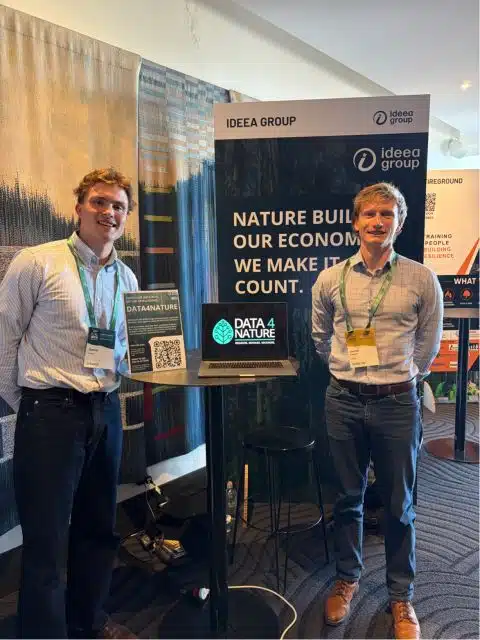
DATA4NATURE (D4N) is our digital platform. It brings together curated spatial and environmental datasets aligned with TNFD, allowing businesses to map their operations against relevant environmental data sets. Businesses provide their operational details, and the platform handles the data processing and spatial analysis. Mapping business operations against environmental data can traditionally take months. With DATA4NATURE, it can now be done in days. 

However, data alone doesn’t tell the whole story. 

Working alongside businesses through the TNFD LEAP approach (Locate, Evaluate, Assess, Prepare), our team interpret what the environmental data reveals, while our analysts assess what it means for the business. Together, we identify the dependencies, impacts, risks and opportunities that matter, translating the findings into a set of prioritised business actions. 


What we learned testing it with real businesses 

We were named a global finalist in the 2026 Nature Intelligence for Business Grand Challenge, where we put our approach to the test with two very different SMEs. 


SME One: Hyakumori (forestry, Japan) 

Hyakumori wanted a credible starting point for responsible forest management and to establish itself as an early adopter of TNFD in its sector. 

The assessment highlighted the importance of healthy forest ecosystems to its operations, while identifying nature-related pressures such as pests. It also identified potential opportunities in recreation and access to nature-related finance. 

Hyakumori’s response to the final report summed up what we were aiming for: “I really appreciate the time, care, and expertise that you and the team have put into this process. The report looks very useful, and we are grateful for the clear summary, insights, and recommendations.” 

Sunao Tabata, Hyakumori 


SME Two: AluTech (aluminium manufacturing, Kazakhstan) 

AluTech needed an environmental baseline to help respond to stakeholder expectations and better understand its exposure to nature-related risks. 

The assessment highlighted its dependence on secure water supplies and its exposure to upstream mining suppliers. It also identified opportunities around water efficiency and access to green capital. 


The common thread 

Both businesses finished with a TNFD-aligned starting point they could take into conversations with customers and funders, along with a clearer sense of what to prioritise next. Neither needed to become a nature expert to get there. 

What stood out was the value of bringing environmental data into a business context. Data on its own can be overwhelming. The real value comes from understanding what it means for the business, and that takes ecological evidence and commercial insight working together. 


Where to start 

You don’t need a full TNFD assessment to begin. Understanding your relationship with nature starts with knowing where your business is exposed and what matters most. From there, the right level of analysis depends on your operations and what your stakeholders expect. 

Your business depends on nature, whether or not you have measured it. We combine DATA4NATURE’s environmental intelligence with the expertise of our analysts to help you understand those dependencies, identify the risks and opportunities, and work out what to do next. 


✕
Director

Mark Eigenraam

Mark has worked in natural capital accounting for over 20 years. He's helped develop environmental markets. And he's worked in academic institutions and government agencies at all levels.
Mark produced Australia’s first set of experimental ecosystem accounts. He also worked at the United Nations in New York on the System of Environmental-Economic Accounting (SEEA) – the international standard.
Mark advises organisations around the world in the application of natural capital accounting. He develops processes and systems that highlight nature-based risks and opportunities.
Mark has a Master of Commerce, Economics, from the University of Melbourne.
✕
DIRECTOR

Carl Obst

Carl is a global leader in natural capital accounting. He helps organisations around the world measure the benefits of nature.
Carl was the lead author of the System of Environmental-Economic Accounting (SEEA) – the international standard.
Carl has a background in national accounts, including five years as head of the Australian National Accounts with the Australian Bureau of Statistics. He uses natural capital accounting to help organisations make effective and sustainable decisions.
Carl has a Bachelor of Economics, Econometrics, from the University of New England (AU).
✕
Senior Economist

Daniel Whitaker

Dan is an experienced practitioner in economics, science, risk management and finance.
His expertise includes natural capital accounting, non-market valuation, nature- and climate-related risk analysis, sustainable finance, environmental-economic modelling and carbon and energy economics and accounting.
Earlier in his career, Dan worked as a sustainability and climate change consultant in PwC’s Risk Consulting team. He then held a position at the National Australia Bank, where he advised on financial and non-financial risk management. This included considerable work on climate risk scenario analysis.
In his role with IDEEA, Dan supports public and private sector organisations on the use of natural capital data in investment decision-making, risk management and economic analysis.
Dan holds a Master of Applied Economics and Econometrics from Monash University.
✕
Senior Economic Analyst

Lachlan Dawson

Lachlan is an adaptable, curious and detail-focused economist with a passion for sustainably managing Australia’s natural capital. His experience encompasses environmental economic accounts, carbon and biodiversity markets and economic modelling.
Prior to joining IDEEA Group, Lachlan worked as a Nature-Climate Solutions Manager with BirdLife Australia and as a Consultant in Environmental Economics with Marsden Jacob Associates.
✕
Economist

Ziggy Gelman

Ziggy is an experienced economist who is passionate about identifying the contribution that ecosystems have to our economy and society. In his role with IDEEA Group, Ziggy provides technical analysis of economic and environmental data and supports organisations to understand and integrate a natural capital approach into their operations.
Ziggy has experience in compiling accounts in Victoria, having worked on ecosystem accounts for urban Melbourne, the Great Ocean Road Coast and Parks, Victoria’s forests and Victoria’s marine and coastal region.
Prior to working at IDEEA Group, Ziggy worked with the Victorian Department of Energy, Environment and Climate Action. Ziggy has a Bachelor of Commerce (Economics and Finance) from the University of Melbourne.
✕
Research Analyst

Maria Angelopoulos

Maria ensures that our client work is accurate, timely and concise. Her broad-reaching research work underpins our natural capital approaches, especially in relation to mapping and collating existing policies and data, and identifying themes.
Maria previously worked as a Research Assistant for Melbourne University’s School of Ecosystem and Forest Sciences where she supported the review of the Montreal Process’ Criteria and Indicator framework on sustainable forest management in Victoria.
Maria holds a Postgraduate Diploma in Environment (Master level program) from the University of Melbourne.
✕
Implementation Support

Michelle Butler

Michelle is dedicated to understanding our clients’ needs and helping them to harness their data to achieve meaningful impact stories and actionable insights.
Her career is marked by a deep commitment to the Victorian landscape and over 30 years in public service, agriculture and the environment sector. Michelle has worked regionally in diverse roles in field science, advised landholders in revegetation and land management, trained teachers, property owners and Landcare facilitators in natural resource management, coordinated statewide grant, crowd-funded and market-based programs, and managed expert teams advising government on biodiversity issues.
Michelle has applied science, teaching and workplace training experience and qualifications.
✕
Head of Advisory and Solutions

Muheed Jamaldeen

Muheed is an economist who helps governments and companies value nature, natural hazards and climate risk, and use those values to make investment decisions. He leads IDEEA’s advisory practice, covering cost-benefit analysis, business cases, economic modelling and forecasting, ecosystem service valuation, input-output modelling and nature-related disclosure.
Muheed is focused on the interaction between climate and nature, and has undertaken studies for both public and private sector clients applying advanced econometric modelling and spatial analytics to tackle some of Australia’s trickiest policy and strategy questions.
Prior to IDEEA, Muheed was a Director at Deloitte Access Economics, where he led the NSW land-use and infrastructure economics practice. Before that he was an Assistant Director at the Federal Treasury, and former Senior Economist at Oxfam. He holds a Master of Economics and a Bachelor of Economics (Hons) from Macquarie University.
✕
GIS Specialist

Daniel Vardon

Daniel manages IDEEA Group’s spatial data infrastructure, ensuring all geospatial datasets are standardised, catalogued and easily accessible across projects.
Daniel develops and maintains workflows that translate raw spatial data into accounts-ready formats for natural capital and environmental reporting. He is passionate about supporting natural capital accounting with high-quality spatial information and analysis.
Daniel has a Bachelor of Environmental Science from the Australian National University and is currently studying for a Master of Geospatial Science at RMIT.