

Please note, this event has been postponed. We will share the new dates as soon as they are confirmed and update accordingly.
One of the challenges we face in the modern economy is encouraging private investment in nature.
Most investors prioritise financial return. But what if there is more to the story? What if we could convince the private sector of the benefits of nature, well beyond the monetary?
Those of you familiar with natural capital accounting will know that we measure beyond the financial, encompassing the services nature provides to the world – like carbon sequestration – and the benefits it brings to us all – like fresh air to breathe.
We work with organisations and governments to help them understand their dependencies and impacts on nature and how prudent investment can bring not only financial reward but wider benefits for the society as a whole.
Let’s look at an example
Using data from the European Union’s Grow Green Project, the EU mapped out the costs and benefits of a sample project, as shown in the diagram below.
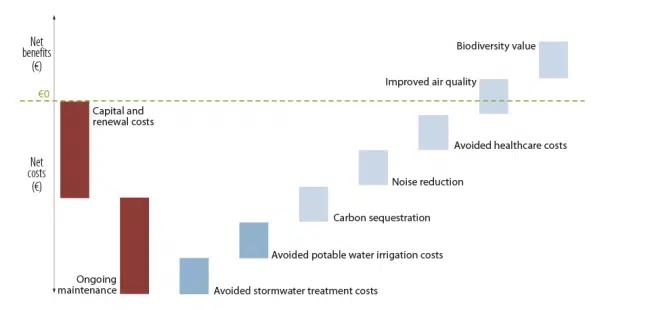 This diagram shows that the cost savings of the project do not exceed the financial investment. In fact, they are well below it. However, the wider benefits – in the form of carbon sequestration, noise reduction, avoided health care costs, improved air quality and biodiversity value – can far exceed the financial investment.
In their report, Investing in nature-based solutions, the EU says the example demonstrates:
‘… one of the greatest challenges for the development of any successful nature-based solutions market: how to incentivise private action if a significant share of benefits is not reaped by private entities.’
Some private entities are jumping on board with nature
We can be heartened by the news that, in the 18 months since the release of the recommendations of the Taskforce for Nature-related Financial Disclosures (TNFD), over 500 organisations have voluntarily committed to getting started with reporting on their nature-related issues. Together, those organisations represent more than USD $17 trillion in assets under management.
Further encouragement lies in the fact that 94 countries currently use the System of Environmental Economic Accounting (SEEA) – the international standard for natural capital accounting.
This means that more and more countries and organisations are realising that nature belongs on the balance sheet.
Measuring the benefits of nature – for everyone
An important aspect of the SEEA is the creation of both physical and monetary accounts for ecosystem services – these are the contributions of ecosystems to the benefits that are used in economic and other human activities. This means that organisations can understand the full benefits of their investments, including the way that the wider benefits outweigh the costs.
The work we did with Cassinia Environmental offers a great example of investment in practice. Cassinia is an Australian environmental impact company that supports healthy, connected and productive landscapes. Over the past 18 years, they have delivered more than 100 projects, positively impacting over 18,000 hectares across three states.
Cassinia’s natural capital accounts informed them that they have achieved a range of benefits beyond the financial, including:
- increasing the condition of habitats and species across their management areas by 31%
- retaining 2,936 tonnes of carbon per annum
- supporting 453 flora species and 49 fauna species, most of which are rare, threatened or vulnerable.
Want to know how this can work in your context?
Connect with us for a chat about how we can support your natural capital journey. We’re experts at putting nature on the balance sheet and helping organisations plan for a sustainable future.