



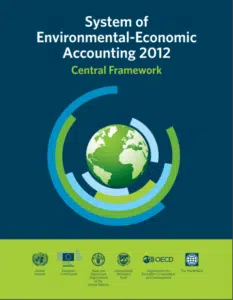
 The System of Environmental-Economic Accounting (SEEA) Central Framework is an international statistical standard for measuring the environment and its relationship with the economy.
To date, 98 countries have used the SEEA to produce natural capital accounts. But the SEEA Central Framework is not only for national governments. Its approach to organising and presenting integrated environmental and economic data is also suitable for use at various scales, from the regional to the local.
Our Director, Carl Obst, is the Lead Editor of the SEEA Central Framework. As you may know, Carl has been the Lead Editor on multiple documents for the SEEA – you can read more about his experience here.
The SEEA Central Framework is currently undergoing an update.
A global consultation process is currently open. Find out about the current consultation via this page. This round closes on Friday 17 April 2026.
Or keep reading for:
- the background to the SEEA Central Framework
- previous consultation on the required updates
- current work
- the current global consultation process
- how you can get involved.
Background
The United Nations Statistical Commission adopted the SEEA Central Framework at its 43rd Session, held in 2012.
Since then, there have been numerous advances and changing demands in the climate change, biodiversity, circular economy and other areas of international environmental policy.
There is also increased recognition of the need to incorporate environmental considerations into economic and financial decision making. In this respect, one very important global policy change was the update to the System of National Accounts (SNA) in 2025 which sets the standards for measuring economic growth. This update recommends a much greater focus on integrated measurement of wellbeing and sustainability and incorporates many of the advances contained in the SEEA Central Framework 2012.
Recognising the increasing relevance of this area of measurement, during 2024, the UN Committee of Experts on Environmental-Economic Accounting (UNCEEA) started a global consultation process about the SEEA Central Framework. They circulated a list of 29 issues and sought feedback from both compilers and users of the accounts.
They received a range of responses that indicated broad support for the list of issues and the way they had prioritised each issue. UNCEEA incorporated the feedback and published a final list of issues. Subsequently, at its 55th Session in 2024, the United Nations Statistical Commission endorsed the proposed update of the SEEA Central Framework.
Current work
Four teams under the direction of the UNCEEA and the SEEA Central Framework Technical Committee are currently working on the following tasks in the following areas:
- overarching issues, including consistency with the SNA
- physical flow accounts
- environmental activity accounts and related flows
- asset accounts.
Each team is producing a series of Guidance Notes. These will explain each of the 29 issues in more detail and provide the technical basis for the recommendations that the UNCEEA will ultimately on changes to the SEEA Central Framework.
Global consultation
To support wide discussion of the issues, the UNCEEA will hold three global consultation rounds about the Guidance Notes throughout 2026. Each consultation round will consider approximately 10 Guidance Notes and run for 6-8 weeks. The first round of global consultation is open now, and the second and third rounds currently planned to commence in May and October.
The consultation will be co-ordinated by the United Nations Statistics Division and is open to anyone interested in contributing to improved measurement of the environment and the economy.
You can participate in the consultation via this page. This round closes on Friday 17 April 2026.
What’s next?
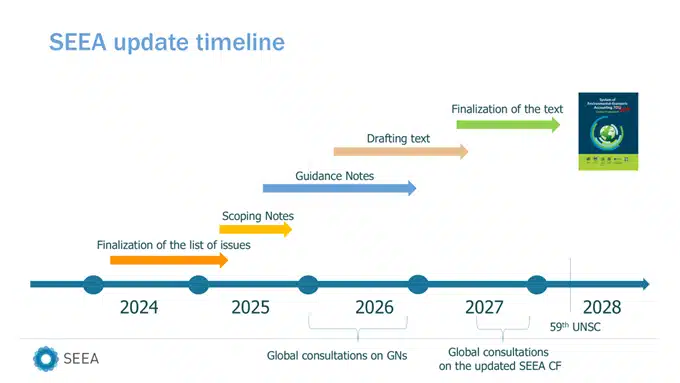
The entire process will take four years, with the final version of the updated SEEA Central Framework due for finalisation and consideration by the United Nations Statistical Commission in March 2028. Figure 1, below, shows the entire timeline.
Figure 1: SEEA CF update timeline from 2024 to 2028